
A solar immersion diverter sends the electricity your solar panels produce, and your home does not use, to the immersion heater in your hot water cylinder. Instead of exporting that surplus to the grid for a few pence, you use it to heat your water. This page explains how a solar diverter works, what it can power, how it is installed and what to look for when choosing one.
What is a solar diverter?
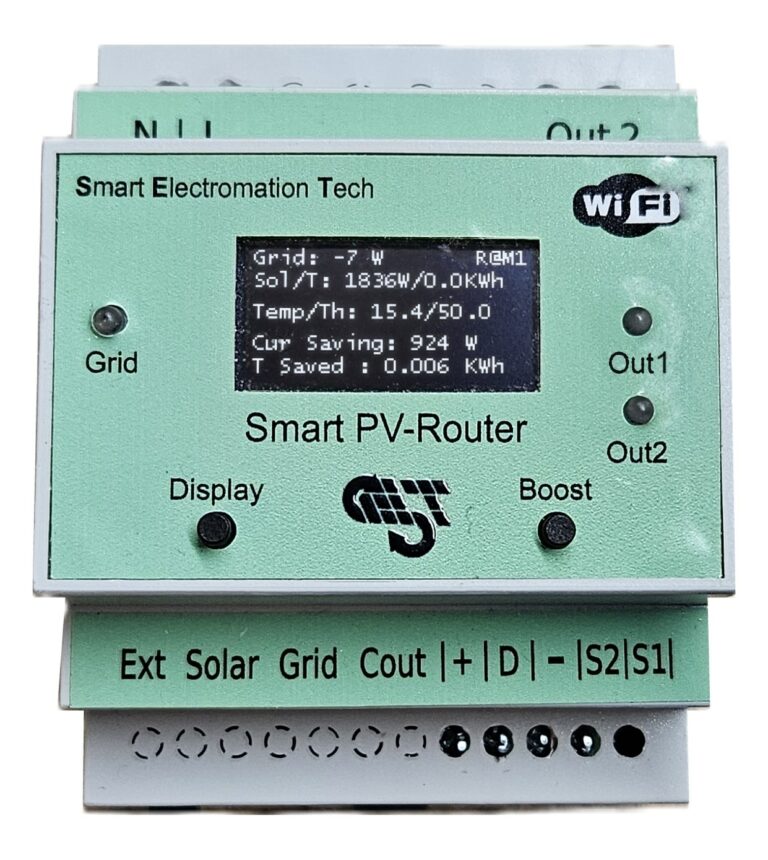
A solar diverter, also called a solar immersion controller or PV diverter, is a small electronic unit installed next to your consumer unit. It constantly measures the power flowing between your home and the grid. As soon as your solar panels produce more than you are using, it diverts the surplus to your immersion heater, which stores it as hot water.
Without a diverter, much of your midday solar production is exported. Under the Smart Export Guarantee, export is paid at a rate well below the price you pay for electricity, and some households are not paid for it at all. A diverter turns that surplus into hot water for the evening and the next morning.
A typical day: solar production and household consumption
Solar productionHousehold consumptionSurplus
The surplus goes to the grid. The water will be heated later, with imported electricity.
The diverter sends the immersion heater exactly the surplus available, here 1,830 W. The hot water is ready for the evening and the next morning.
Why a timer or a simple relay is not enough
A timer or relay switches the immersion fully on or off. A typical immersion heater draws 3 kW: with 800 W of surplus, switching it on means importing 2.2 kW from the grid.
A diverter varies the power continuously instead. With 430 W of surplus, the immersion receives 430 W, so you use all of your surplus without importing anything.
Not all-or-nothing: the power follows the surplus
The diverter adjusts the power sent to the immersion heater in real time, almost to the watt. It rises and falls with the surplus.
Immersion powerSolar surplusImported from the gridUnused surplus
Switched by a timer, the immersion runs at full power or not at all, regardless of the surplus. While on, it imports whatever the surplus does not cover. While off, the surplus is exported.
Power sent to the immersionSolar surplus, fully used
A cloud passes, the kettle goes on: the immersion power drops at once, then rises again with the surplus.
On/off control has its place too. Driven by the measured surplus rather than by a timer, a simple contactor also sends solar surplus to the water heater: that is the Eco-Contactor version of the Smart Tri-Meter, economical by design, single-phase or three-phase. For fine, watt-accurate control, the solar diverter remains the answer.
Example: a 3 kW immersion heater and 800 W of solar surplus
How the Smart PV-Router works
- Measure. A current clamp on the incoming supply shows at every moment whether your home is importing or exporting.
- Calculate. As soon as export is detected, the router knows exactly how much surplus is available.
- Regulate. It sends exactly that power to the immersion heater, to the watt.
This happens 50 times per second (every 20 ms), inside the unit, with no cloud. When a cloud passes or the kettle goes on, the power adjusts immediately.
What can a solar diverter power?
Immersion heater: the main use
An immersion heater in a hot water cylinder is the ideal load: it accepts any power level (the Smart PV-Router handles up to 3,600 W per output), stores energy for hours and is already fitted in many UK homes. Its own thermostat stays in place as a safety cut-out, and a temperature sensor on the router can set the target temperature.
Other resistive loads
Electric radiators, towel rails, electric underfloor heating or a pool heater can use surplus too. With two independent outputs, the Smart PV-Router heats the cylinder first, then sends the remaining surplus to a second load.
Heat pumps
A heat pump cannot be dimmed. The Smart PV-Router switches it through an SG-Ready input or a 0–10 V signal when there is enough surplus.
Home battery and EV charging
With a home battery, the surplus must be shared between the battery and the cylinder, otherwise they compete for the same energy. The Smart PV-Router Hybrid manages both. The Smart Wallbox charges an electric car from surplus, in coordination with the router.
Single-phase or three-phase?
Most UK homes have a single-phase supply, which the standard Smart PV-Router covers. On a three-phase supply, the router must measure all three phases to know the real surplus: the three-phase module with the Smart Tri-Meter does exactly that.
Single-phase supply (most UK homes): the standard Smart PV-Router.
Three-phase supply: the three-phase solar diverter, with the Smart Tri-Meter measuring all three phases.
Is a solar diverter worth it?
Every kWh your immersion takes from the surplus is a kWh you do not buy from the grid. The saving is easy to estimate:
If you are not paid for export, every diverted kWh saves the full import price. The larger your midday surplus and the more hot water you use, the faster a diverter pays for itself.
Installation
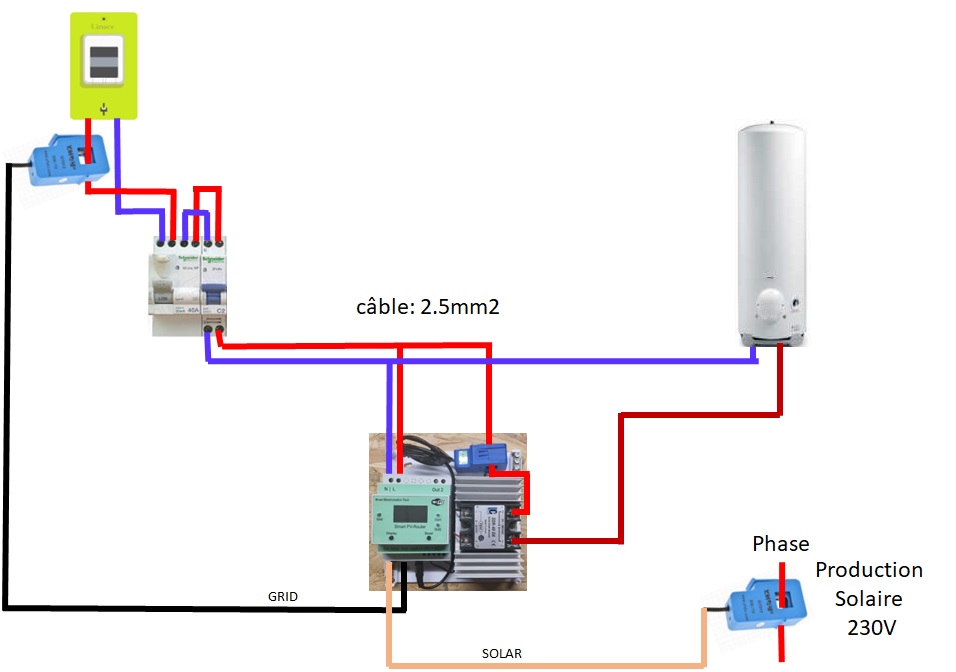
- Measurement on the incoming supply, right after the meter.
- The router, on a DIN rail in an enclosure next to the consumer unit.
- The immersion heater, connected to the router output.
- Wi-Fi connection, for monitoring and settings.
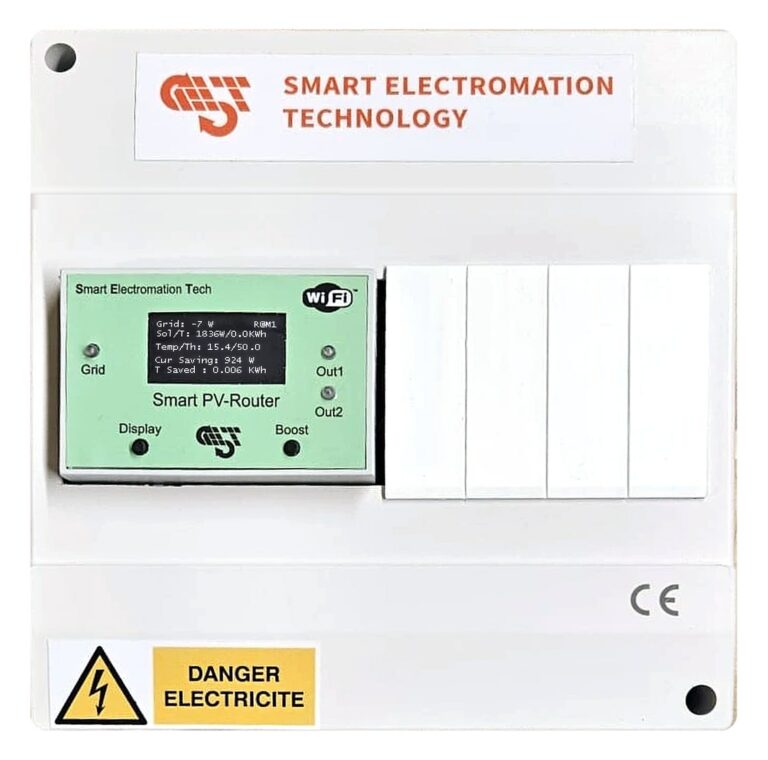
If the meter is far from the cylinder, a remote measurement module avoids running a cable between them. A pre-wired enclosure arrives assembled and shortens installation.
The installation involves your consumer unit and must be carried out by a qualified electrician in accordance with BS 7671.
How to choose a solar diverter
Seven criteria make the difference between two models.
The Smart PV-Router
The Smart PV-Router by Smart Electromation Technology is designed and built in France and runs in hundreds of installations.
The seven criteria, applied to the Smart PV-Router
Also:
- Up to 3,600 W per output.
- Load shedding: cuts the outputs before your supply limit is exceeded.
- On/off mode for appliances that cannot be dimmed.
- Pre-wired enclosures that arrive assembled.
It measures and communicates
 Smart PV-RouterLocal regulation every 20 ms
It powers and controls
Discover the Smart PV-Router range
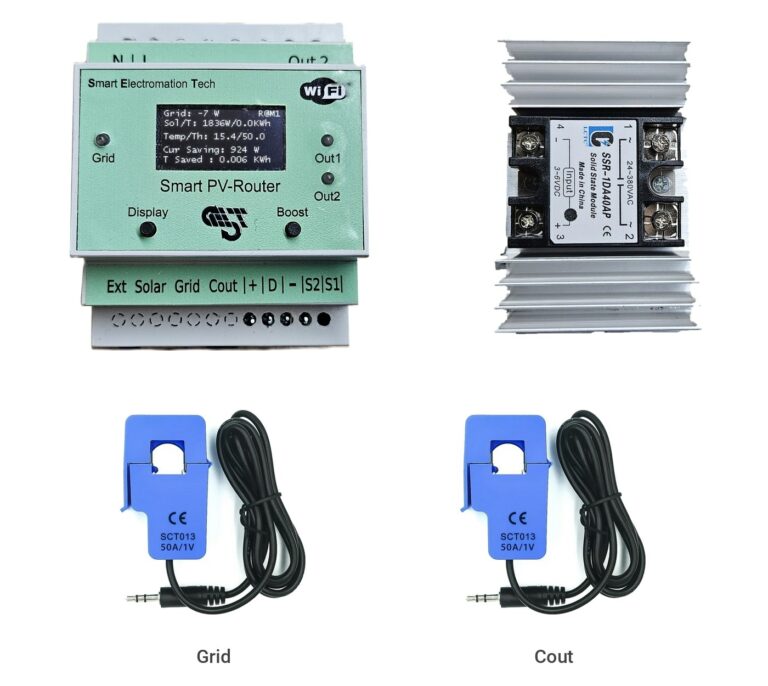 Smart PV-RouterThe solar diverter on a DIN rail: two outputs, regulation every 20 ms.Discover →
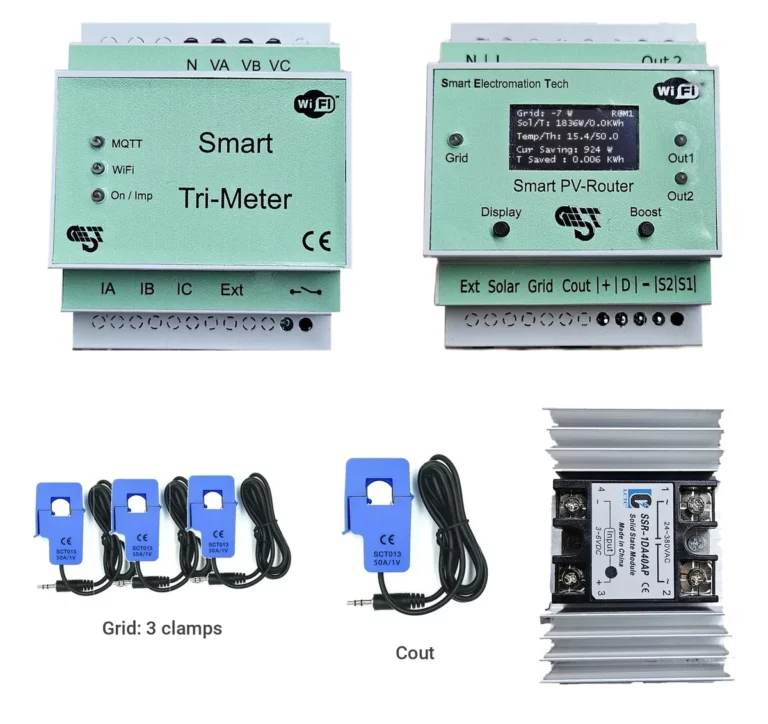 Three-phase solar diverterThe Smart PV-Router combined with the Smart Tri-Meter, to measure all three phases.Discover →
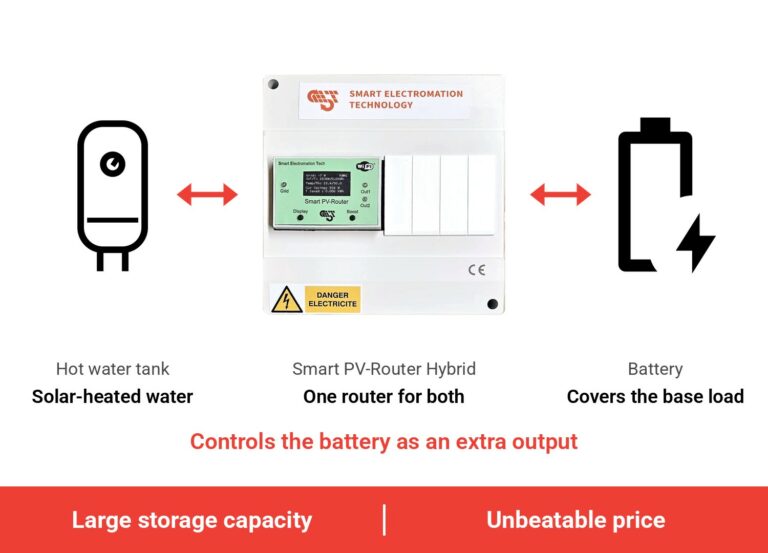 Smart PV-Router HybridOne router for the hot water cylinder and the battery.Discover →
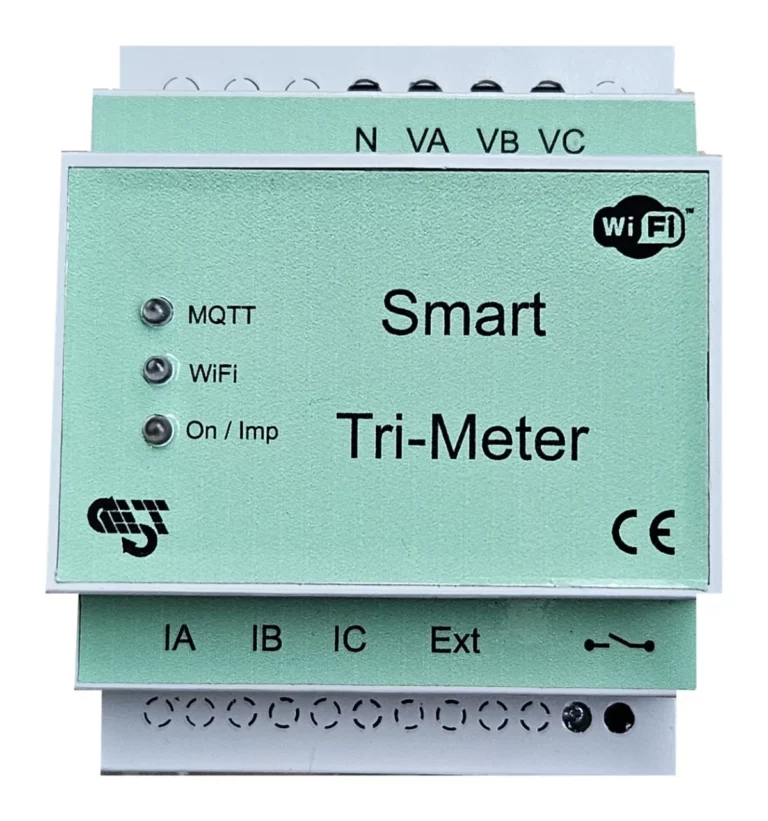 Smart Tri-MeterA connected energy meter, or an Eco-Contactor that sends your solar surplus to the water heater.Discover →
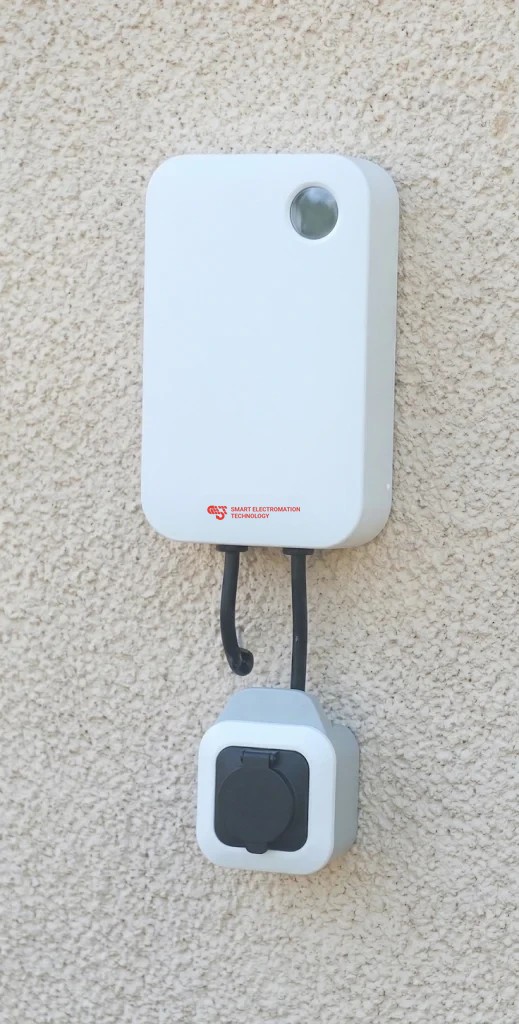 Smart WallboxCharges your electric car from solar surplus.Discover →
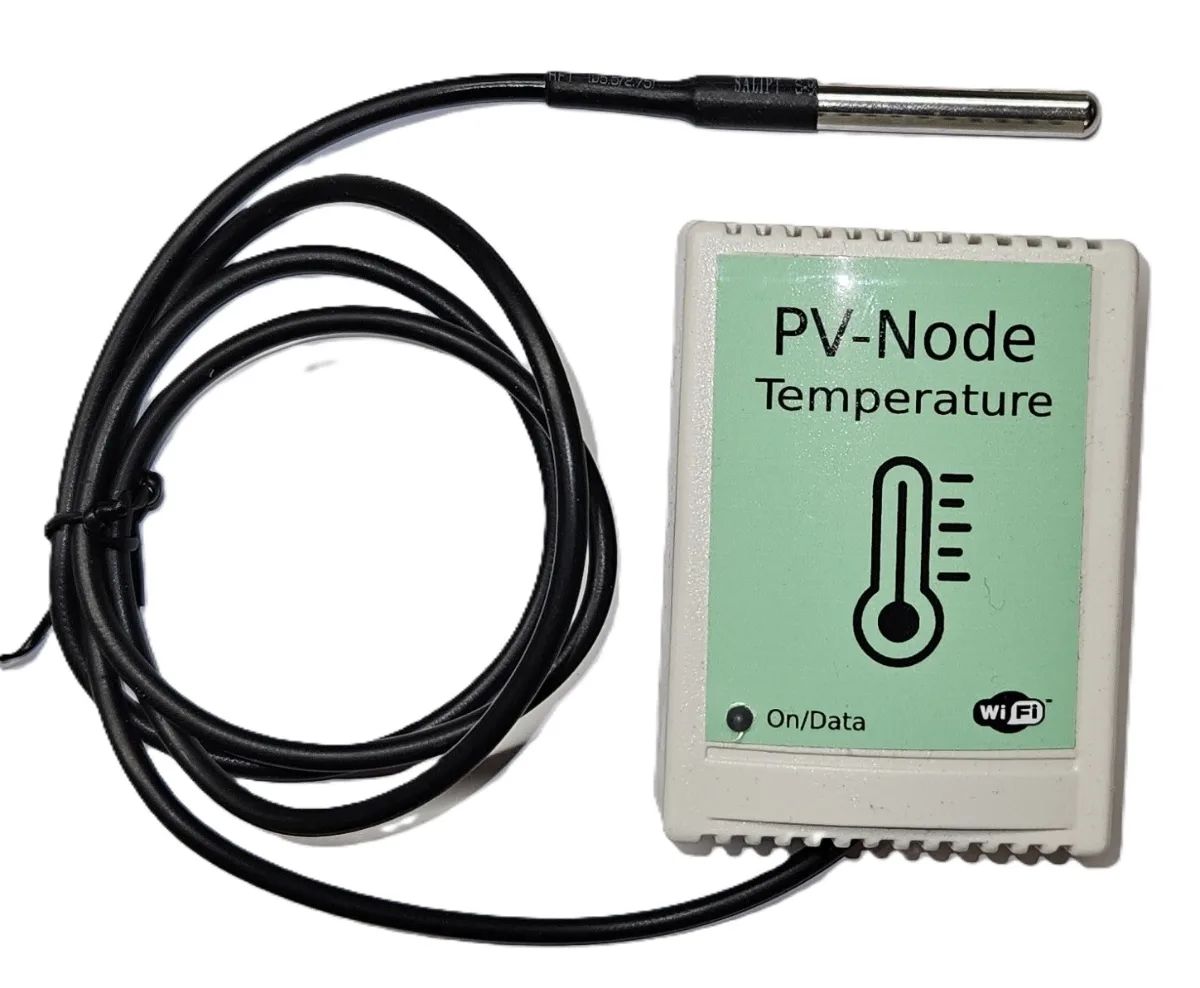 Modules and accessoriesTemperature sensors, Wi-Fi modules, remote measurement, pre-wired enclosures.Discover →
Planning a solar diverter?
Let’s talk about your installation.
Warranty, returns and delivery
- 2-year warranty.
- 14-day right to cancel after delivery.
- Delivery to the United Kingdom and across the European Union.
- Quotes in pounds sterling (£), with a quick reply by email.
Solar diverter FAQ
How much does a solar diverter cost?
The price depends on your installation: single-phase or three-phase, number of outputs, DIN-rail unit or pre-wired enclosure, accessories. We quickly prepare a quote for your project, in pounds sterling: contact us with a short description of your installation.
Can I keep my existing immersion heater?
Yes, in most cases. The diverter only replaces the way the immersion is controlled, not the immersion itself.
I have a combi boiler. Is a diverter useful?
A combi boiler heats water on demand and has no cylinder, so there is no hot water store to divert to. A diverter can still feed electric heating such as radiators or a towel rail.
Does a diverter work with a home battery?
Yes. The battery stores electricity for the evening, the cylinder stores heat at a much lower cost. The Smart PV-Router Hybrid shares the surplus between the two.
Does it work without internet?
Yes. Regulation runs inside the unit, with no cloud. Wi-Fi is only used for monitoring and settings, and the router keeps 90 days of data if the connection drops.
What happens when there is not enough sun?
The router can top up at a set time, for example on a cheaper off-peak tariff such as Economy 7, and only if the cylinder has not reached its temperature during the day. A Boost function provides hot water quickly when needed.
Do you deliver to the UK?
Yes. We deliver to the United Kingdom and across the European Union. The app, the manual and support are available in English.