
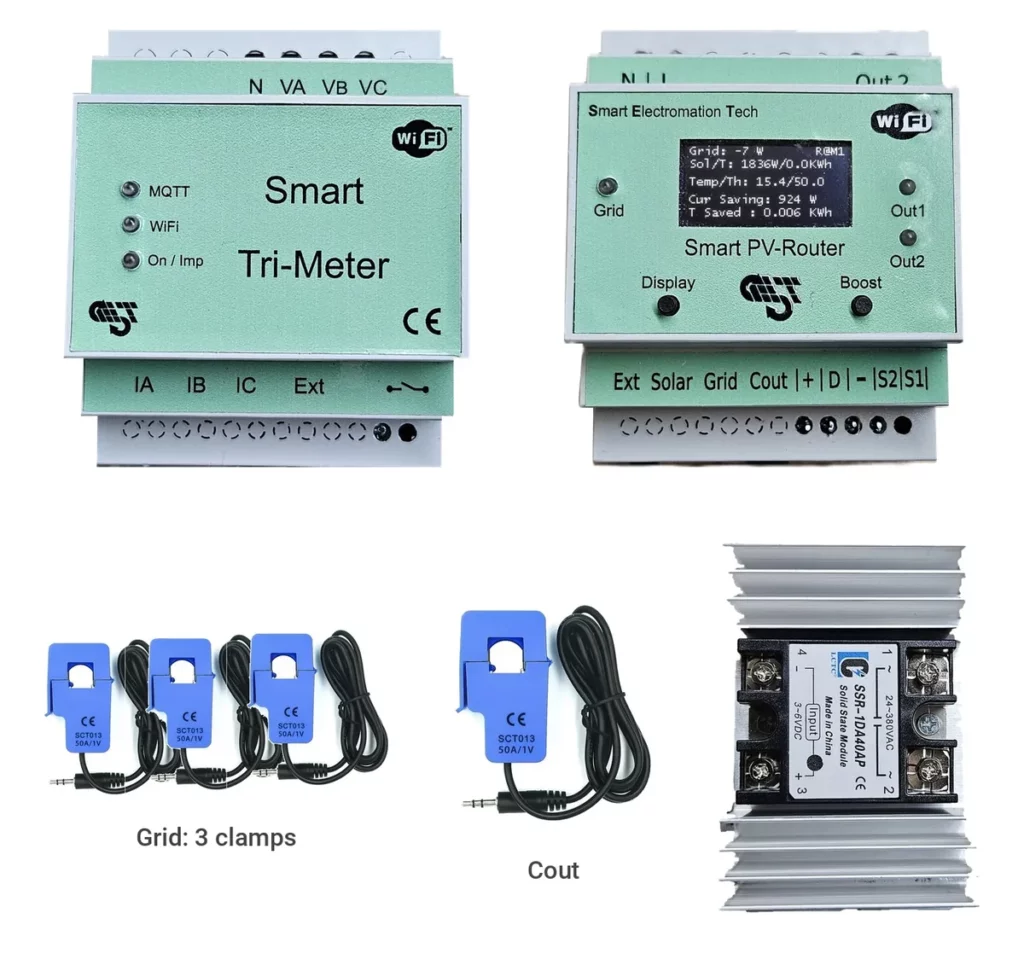
Three-phase solar diverter · French manufacturer
Three-phase solar diverter for your water heater
Is your installation three-phase? The three-phase diverter combines the Smart PV-Router with the Smart Tri-Meter: it measures the net balance of your 3 phases, just like your electricity meter, and sends your solar surplus to the water heater instead of exporting it to the grid.
Price: Quote within 24 hours
How does a three-phase diverter work?
On a three-phase supply, the meter usually does not count each phase separately: it records the net balance of the 3 phases. If one phase exports while another imports, the two offset each other, and it is this balance that appears on your bill.
The diverter works exactly the same way:
- the Smart Tri-Meter measures voltage and current on all 3 phases, in both directions;
- the Smart PV-Router calculates the sum of the 3 phases and adjusts the diversion every 20 ms (50 times per second);
- as soon as the balance shows a surplus, it is sent to the water heater, adjusted to within 1 W: this is Zero Export.
The water heater stays single-phase
The water heater must be connected in single-phase, on one of the phases. Most three-phase water heaters can be wired in single-phase. Because the diverter works on the balance of the 3 phases, the surplus produced on any phase is used to heat the water.
Why a dedicated meter rather than the utility meter?
The diverter does not read the utility meter’s data output. Measurement is done by the Smart Tri-Meter, designed for the Smart PV-Router, or by a Shelly Pro 3EM: it is faster and does not depend on your supplier’s meter.
The equipment
The three-phase DIN-rail kit includes the Smart PV-Router, the Smart Tri-Meter and its 3 CT clamps (one per phase, on the grid side), a MOSFET-based 40 A / 380 V solid-state relay (SSR) with its DIN-rail mount, and a CT clamp to measure the power sent to the appliances.
The diverter is also available as an enclosure version. The Smart Tri-Meter communicates with the Smart PV-Router by wire, Wi-Fi, RS485 or LoRa.
All the Smart PV-Router features
- 2 outputs, water heater first; output 1 can be driven by 0–10 V.
- Off-peak hours: 2 programmable time slots; Boost when you urgently need hot water.
- Overload protection: keeps you within your supply limit.
- Legionella protection: heats to 65 °C if the water has not reached it within 4 days (with probe).
- Monitoring on PC, tablet and smartphone; 90 days of data stored, even with the Wi-Fi off.
- Open API: HTTP, JSON, MQTT, REST; compatible with Home Assistant and Jeedom, and with ioBroker and openHAB via MQTT and REST API.
Frequently asked questions
My water heater is three-phase: can I use the diverter?
Yes, provided it is wired in single-phase. Most three-phase water heaters allow this; your electrician can do it.
Does the diverter work phase by phase?
No. It works on the sum of the 3 phases, like the meter. This balance determines what you actually export to the grid.
Can I use the utility meter instead of the Smart Tri-Meter?
No. Measurement is always done with the Smart Tri-Meter, or with a Shelly Pro 3EM.
Can I control a second appliance?
Yes. The Smart PV-Router has 2 outputs; the second requires a second SSR, available as an accessory.
My generation and consumption are on different phases: is that a problem?
No. The diverter only looks at the overall balance of the 3 phases: it does not matter which phase your inverter produces on or your appliances consume on.